
Apart from the retired service chiefs, dozens of former commanders and some retired junior commissioned officers, who met in the garrison city of Rawalpindi on Tuesday, blamed Musharraf for the current crisis in Pakistan and asked him to step down.
The Bush administration has said that it considers Pakistan President General Pervez Musharraf as an "absolutely essential ally" in the war on terror and it would continue to work with him.
It was the civilian leadership that was disinclined to withdraw fearing loss of face, the former US Central Command chief has said.

After news about the demise of Pakistan's former president General Pervez Musharraf was confirmed, the country's Foreign Minister Bilawal Bhutto Zardari on Sunday changed his Twitter profile picture to a photograph of his mother Benazir Bhutto and the late Nawab Akbar Bugti, in whose murder the former military ruler was named.
Posters of General Musharraf will be put up in cities, towns and villages across the country. PML leaders will also organise seminars and public meetings to convince the public to vote for the president.

Pakistan's former military ruler General Pervez Musharraf's body will be laid to rest in Karachi, and will be brought back to the country on a special flight that will leave for Dubai on Monday, media reports said.

Pakistan's former army chief Gen Pervez Musharraf kept Gen Ashfaq Parvez Kayani in the dark about Kargil Operation in 1999 despite the latter heading forces responsible to guard (Pakistan-occupied) Kashmir, according to a new book by a former general.

In the book, Anger Management: The Troubled Diplomatic Relationship Between India and Pakistan, Bisaria says this public telecast sounded to observers like a mid-summit report on the talks, where Pakistan's hard views were being inflicted on India, while New Delhi's positions were unclear.
In an interview with the local KTN station late on Saturday, Bhutto said, "We do not accept President Musharraf in uniform. Our stand is that, and I stick to my stand."

Tharoor's remarks came after several BJP leaders accused the Congress of 'Pakistan parasti (worship)' and Union minister Jyoritiraditya Scindia asked if this was part of the 'Haath Se Haath Jodo Abhiyan' with enemies.
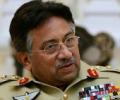
Several retired Pakistani generals have warned that the military might react if there is any move by lawyers or the judiciary to humiliate former army chief Pervez Musharraf, according to a media report on Tuesday.
Former Pakistani Generals, including ex-army chief Mirza Aslam Beg, have criticised President Pervez Musharraf's handling of the Kashmir problem and said there could be no long-term friendship with India unless the issue is resolved.
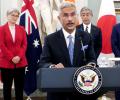
If the only superpower, which calls India an ally, sees the region through an India-Pakistan prism, it is unacceptable. Rather than endorse India's sphere of influence, this undermines it, asserts Shekhar Gupta.

Tharoor's social media post condoling Musharraf's demise evoked a sharp response from the Bharatiya Janata Party which accused the Congress of "Pakistan parasti (worshipping)".
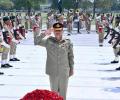
India had better be prepared. Munir could be back at our throats soon, even within the next 12 months, warns Shekhar Gupta.

Musharraf, 79, was suffering from amyloidosis, a rare disease caused by a build-up of an abnormal protein called amyloid in organs and tissues throughout the body, The Express Tribune reported.
Former military ruler Pervez Musharraf kept such a tight lid on intrusions by Pakistani troops into Indian territory in Kargil in 1999 that the Inter-Services Intelligence learnt of the development when it intercepted Indian Army communications, a retired general says in his new book.
Pakistan's Foreign Minister Ishaq Dar has called for a 'composite dialogue' with India to address the contentious issues between the two sides.

'We are too important to want to be paired with Pakistan but too intensely connected to it to successfully detach ourselves,' asserts Aakar Patel.

After his failed misadventure in Kargil, Musharraf deposed the then Prime Minister Sharif in a bloodless coup in 1999 and ruled Pakistan from 1999 to 2008 in various positions.

Lakshmipathy Balaji turned out to be the cynosure of all eyes during the Indian cricket team's tour of Pakistan in 2004.

In a statement after a meeting between Trump and Pakistan Army chief Asim Munir at the White House on Wednesday, the Inter-Services Public Relations -- the media wing of the Pakistan Army -- said they also discussed joint counterterrorism efforts.
The closed-door luncheon meeting came amid escalating tensions between Israel and Iran with Trump exploring Washington's possible involvement.

Amid reports that the Pakistan government was under pressure to allow Pervez Musharraf to leave the country, the former military ruler on Sunday said he will not flee and defend himself in all cases.

'Pakistan's only concern has been while they were on the FATF watch list was to distance their State institutions and organs from any direct connection with the actual execution of militancy inside Kashmir.'
It is time we buried the mantra of 'peaceful and stable Pakistan is in our interest'. It is not, simply because Pakistan's existence -- that is synonymous with its army -- means peace has no chance, asserts Colonel Anil A Athale (Retd). It is time we buried the mantra of 'peaceful and stable Pakistan is in our interest' asserts Colonel Anil A Athale (Retd).
The Balochistan Liberation Army (BLA) has undergone a significant transformation, evolving from hit-and-run attacks to carrying out sophisticated operations with tactical precision. The group's tactics and targets have become increasingly audacious, targeting security forces, Chinese nationals, and innocent civilians. Experts attribute the BLA's evolution to various factors, including the leadership of Bashir Zeb, the group's growing intelligence network, and its exploitation of the grievances of the Baloch people. The BLA's actions are a cause for concern, as the group's sophisticated attacks pose a major challenge to security forces.
Jammu and Kashmir Chief Minister Omar Abdullah has said that India and Pakistan came closer to resolving the Kashmir issue during the Manmohan Singh-led UPA government. He added that he does not expect a return to that situation in his lifetime. Abdullah lauded Singh's efforts on Kashmir, including the setting up of working groups on the issue, and said he practically initiated measures for the return of displaced Kashmiri Pandits. The chief minister also praised Singh's contribution to India's economic development.

The special court of Islamabad on December 17 last handed down the death penalty to 74-year-old Musharraf after six years of hearing the high-profile treason case against him. The case was filed by the Pakistan Muslim League-Nawaz government in 2013.
Prince Karim Al-Hussaini, Aga Khan IV, the 49th hereditary Imam of the Shia Ismaili Muslims, passed away in Lisbon at the age of 88 on Tuesday, February 4, 2025.

If General Asim Munir, Pakistan's new army chief, wants to help defuse the current polarised atmosphere and shepherd civilian politicians towards negotiations on an acceptable date for elections, he may need to distance himself from any perception of needless hostility to Imran Khan, explains Rana Banerji, who headed the Pakistan desk at RA&W, India's external intelligence agency.

'There's a lot of sense in what Prime Minister Modi did, but the Indian government has to be really prepared for a really sharp escalation spiral.'

In his speech, General Munir highlighted the role of the army in defending the motherland with the support of the people of Pakistan and also touched upon various conflicts with India, including the Kargil War.
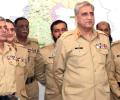
Senior general refuses to retire, reveals Rana Banerji, who headed the Pakistan desk at the Research and Ananlysis Wing, India's external intelligence agency.
What Musharraf doesn't understand is that deposed dictators are like used toiler paper: No one has any use for them and hence, they are best discarded, says Sushant Sareen.
Manmohan Singh and Musharraf felt that what they were embarking upon, if successful, could lead to a future of boundless potential for the two countries and for the relationship that was hard to foresee from the prism of the existing situation and the historical position and orthodox ideas on both sides.
The ex-army chief left for Dubai for medical treatment in March 2016 and has not returned since, citing security and health reasons.
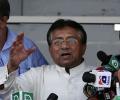
Musharraf, the 74-year-old retired general who is in self-exile in Dubai, said that Mumbai attack mastermind Saeed "is involved in Kashmir" and he supports their involvement.
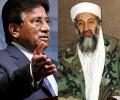
Former Pakistani military dictator Pervez Musharraf possibly knew about slain Al Qaeda leader Osama bin Laden and his place of hiding, an eminent British journalist who reported for years from Afghanistan and Pakistan for the New York Times has claimed.

When asked to explain, Musharraf, 73, said Gen Sharif played a role in "releasing the pressure" on courts to prevent him from leaving the country.
